Jonathan Turley Warns America Is Losing Faith in the Constitution Amid Key Supreme Court Battles
Jonathan Turley Warns America Is Losing Faith in the Constitution Amid Key Supreme Court Battles
Legal Scholar Says Declining Civic Education and Political Division Threaten America’s Founding Principles
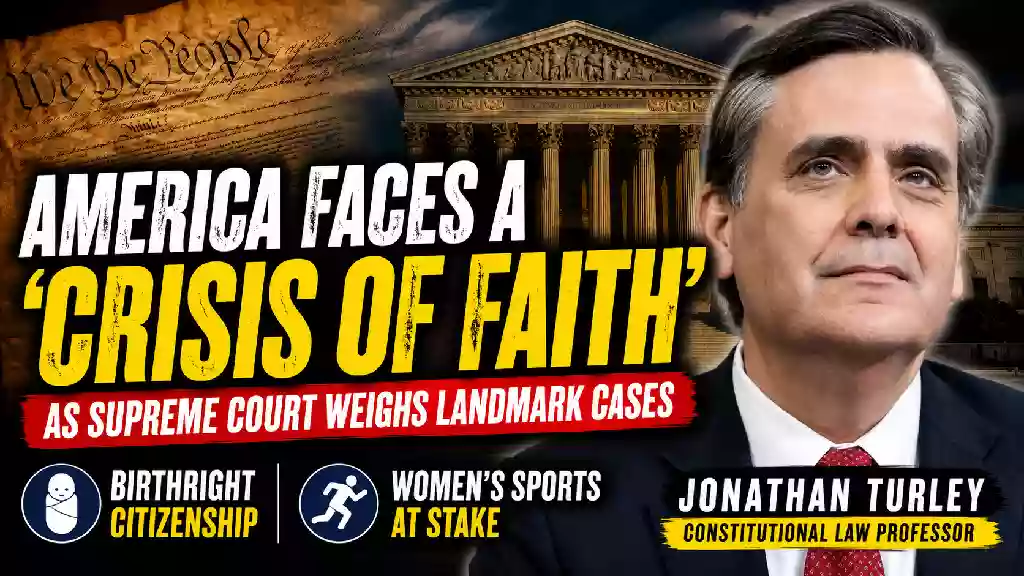
As the U.S. Supreme Court prepares to deliver decisions in several of its most consequential cases this term, constitutional law professor Jonathan Turley says the nation is confronting a deeper challenge than legal disagreements. According to Turley, the United States is experiencing a growing loss of confidence in its constitutional institutions, fueled by political polarization and a decline in civic education.
During a television interview, Turley discussed pending Supreme Court cases involving birthright citizenship and state laws regulating participation in girls’ and women’s sports. While those legal disputes could shape American law for years to come, he argued that the larger issue is whether Americans still understand and trust the constitutional principles that have guided the country for nearly 250 years.
Supreme Court Set to Decide Major Constitutional Questions
Among the Court’s most anticipated rulings is a challenge involving Donald Trump’s executive order seeking to limit birthright citizenship for children born in the United States to undocumented immigrants.
Turley acknowledged that long-standing Supreme Court precedent makes changing the current interpretation of the Fourteenth Amendment difficult. However, he argued that historians continue to debate the original intent of the amendment and whether it was designed to provide automatic citizenship under every circumstance.
While recognizing the importance of precedent, Turley said that if Americans wish to fundamentally change birthright citizenship, the more appropriate path would likely be a constitutional amendment rather than judicial reinterpretation.
The issue has remained at the center of the national immigration debate, with supporters and critics offering competing constitutional interpretations.
Women’s Sports Case Could Expand State Authority
Turley also commented on another closely watched Supreme Court case involving state laws that restrict participation in girls’ and women’s sports based on biological sex.
After reviewing the oral arguments, he said the justices appeared receptive to allowing states to establish eligibility rules for athletic competition. Although he emphasized that no outcome is certain until the opinions are released, he believes the Court may ultimately side with state governments.
Such a decision could have lasting implications for schools, athletic associations, and future legal disputes involving gender identity and equal protection under the law.
A Warning About America’s Constitutional Culture
Beyond the legal cases, Turley expressed concern about what he described as a broader erosion of public confidence in America’s constitutional system.
He argued that growing calls to reshape or expand the Supreme Court demonstrate a weakening commitment to long-standing constitutional traditions. In his view, the challenge facing the country is not that the Constitution has failed, but that many Americans have lost faith in the institutions designed to uphold it.
Turley said the United States remains unique because its founding philosophy recognizes individual rights as inherent rather than granted by government. He suggested that the nation’s approaching 250th anniversary presents an opportunity to renew appreciation for those founding ideals and strengthen public understanding of constitutional government.
Civic Education Takes Center Stage
A major focus of Turley’s interview was the decline of civic education in the United States.
He argued that many students leave high school and college with only a limited understanding of the Constitution, the Bill of Rights, and the structure of American government. According to Turley, that educational gap contributes to growing political division and weakens informed public debate.
Turley also criticized what he described as ideological divisions within some institutions of higher education, arguing that students should be encouraged to study America’s founding principles through open discussion and historical context.
While opinions differ on the state of higher education, many educators agree that improving civic literacy remains an important goal for strengthening democratic participation.
Supreme Court Decisions Will Shape the National Conversation
The Supreme Court’s upcoming opinions on birthright citizenship, women’s sports, and other constitutional issues are expected to influence legal and political debates well beyond this term.
For Turley, however, the significance of these cases extends beyond the courtroom. He believes they serve as a reminder that preserving constitutional government depends not only on judges and elected officials, but also on an informed public that understands the nation’s founding principles.
As Americans await the Court’s decisions, debates over constitutional interpretation, civic education, and the role of the judiciary are likely to remain central to the country’s political landscape. Regardless of the legal outcomes, Turley’s message is that the future of American democracy ultimately rests on whether citizens continue to value and defend the constitutional system that has shaped the nation for nearly two and a half centuries.
#JonathanTurley #SupremeCourt #Constitution #CivicEducation #BirthrightCitizenship #LegalNews #AmericanDemocracy #RuleOfLaw #USPolitics