Bipartisan Senate Proposal Aims to End Government Shutdowns and Keep Federal Services Running
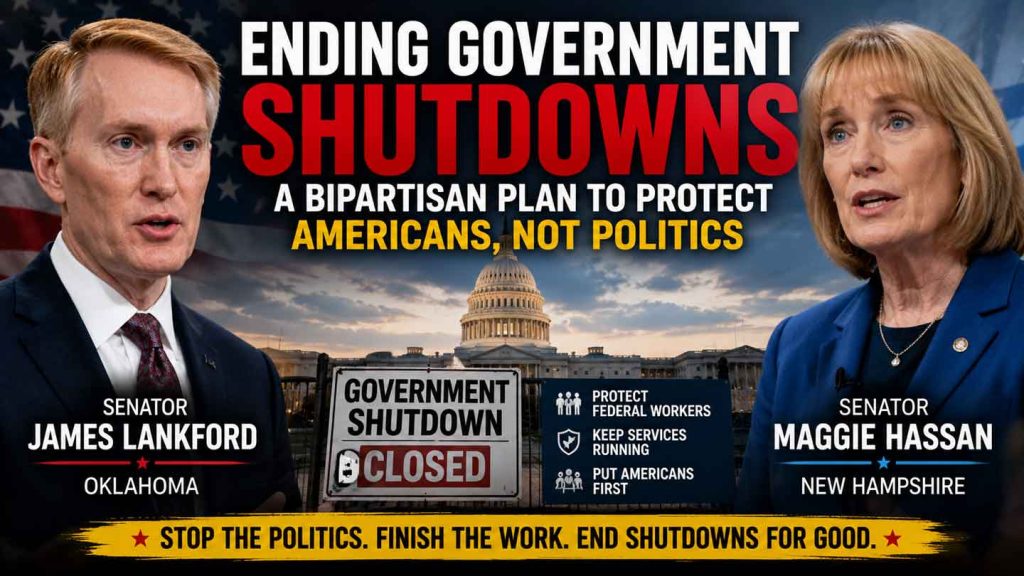
Bipartisan Senate Proposal Aims to End Government Shutdowns and Keep Federal Services Running
Senators James Lankford (R) and Maggie Hassan (D) Renew Push for Legislation Designed to Prevent Future Funding Standoffs
WASHINGTON, D.C. — Government shutdowns have become a recurring source of frustration for Americans over the past decade, disrupting services, creating uncertainty for federal employees, and adding billions of dollars in costs to the economy. Now, a bipartisan group of lawmakers is once again pushing a proposal they believe could bring an end to the cycle.
U.S. Senator James Lankford of Oklahoma and U.S. Senator Maggie Hassan of New Hampshire have reintroduced legislation aimed at preventing future federal government shutdowns while increasing pressure on Congress to complete its budget responsibilities on time.
The proposal, known as the Prevent Government Shutdowns Act of 2026, seeks to ensure that government operations continue even when lawmakers fail to reach an agreement on annual spending bills before funding deadlines expire.
Shutdowns Have Impacted Millions of Americans
Federal government shutdowns occur when Congress and the President fail to approve funding legislation necessary to keep government agencies operating. While some essential functions continue during shutdowns, many federal services are reduced or temporarily suspended.
According to the senators, shutdowns create significant disruptions that extend far beyond Washington politics.
Previous shutdowns have resulted in delayed services for veterans, disruptions to federal benefit programs, reduced staffing at airports, and uncertainty for federal workers and military personnel. During past funding lapses, Transportation Security Administration (TSA) employees and air traffic controllers were required to continue working despite delays in receiving paychecks.
Small businesses seeking assistance through federal programs have also experienced delays, while families dependent on government services have faced uncertainty regarding benefits and support programs.
Supporters of reform argue that these consequences often affect ordinary Americans far more than the elected officials responsible for resolving budget disputes.
New Plan Would Automatically Continue Funding
Under the proposal, if Congress fails to pass one or more of the annual appropriations bills before the funding deadline, an automatic Continuing Resolution would immediately take effect.
A Continuing Resolution, commonly known as a CR, temporarily extends current funding levels and allows federal agencies to continue operating while lawmakers negotiate a final budget agreement.
The legislation would keep federal employees on the job, maintain government services, and prevent the disruptions commonly associated with shutdowns.
Advocates of the bill say this approach would protect citizens from becoming collateral damage in political disputes while still encouraging lawmakers to finish their work.
Congress Would Feel the Pressure Instead
While the proposal shields federal workers and government services from shutdown impacts, it places additional pressure directly on Congress.
If funding deadlines are missed, members of Congress and their staffs would be required to remain in Washington and continue working until appropriations bills are completed.
The House and Senate would also face restrictions on what legislation could be considered during that period. Under the proposal, lawmakers would be required to focus primarily on resolving the budget impasse before turning their attention to other matters.
Supporters describe the concept as similar to students staying after school to complete unfinished assignments.
The goal is to ensure that the consequences of missed deadlines are experienced by lawmakers rather than federal employees, military personnel, or the American public.
Bipartisan Support Continues to Grow
The legislation represents a rare example of bipartisan cooperation in an increasingly polarized political environment.
Lankford, a Republican, and Hassan, a Democrat, have worked together on the issue for several years, arguing that preventing shutdowns should be a shared priority regardless of political differences.
According to the senators, a previous version of the proposal received substantial bipartisan backing in Congress but fell just a few votes short of advancing.
Since then, interest in reform has continued to grow among lawmakers who believe the current budget process is failing to serve taxpayers effectively.
Several organizations representing federal employees, along with various policy groups from across the political spectrum, have expressed support for efforts to eliminate government shutdowns as a negotiating tactic.
Addressing a Costly Problem
Government shutdowns carry significant financial costs in addition to service disruptions.
Analysts have estimated that previous shutdowns have cost the federal government billions of dollars through lost productivity, delayed projects, administrative expenses, and economic ripple effects.
Supporters of the Prevent Government Shutdowns Act argue that maintaining government operations while Congress continues negotiations could save money and reduce uncertainty for businesses, workers, and families.
They also contend that eliminating shutdown threats would strengthen public confidence in government institutions and demonstrate greater stability to international allies and financial markets.
Looking for a New Path Forward
While disagreements over federal spending are likely to remain a regular part of American politics, supporters of the legislation believe there are better ways to resolve those differences than allowing government operations to grind to a halt.
The proposal does not eliminate debates over taxes, spending, or policy priorities. Instead, it attempts to separate those debates from the services millions of Americans rely on every day.
As Congress continues to wrestle with budget challenges and funding deadlines, lawmakers behind the bill say the focus should remain on protecting citizens from the consequences of political gridlock.
Whether the legislation ultimately becomes law remains uncertain, but its supporters argue that ending government shutdowns would represent an important step toward a more predictable and functional federal budget process.
Tom Homan Warns “Justice Is Coming” for Those Funding Anti-ICE Protests
Keane: U.S. Actions Could Put Iran’s Regime on a “Pathway to Collapse”