Nathan Sales Says US Can Sustain Pressure on Iran as Economic and Military Stakes Rise
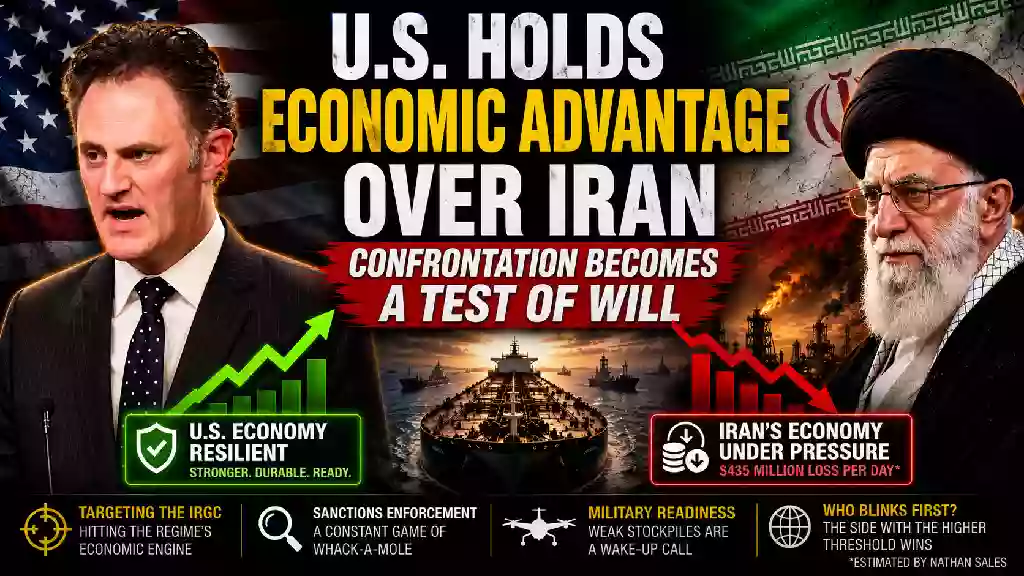
Nathan Sales discusses the U.S. strategic advantage over Iran as economic sanctions, pressure on the Iranian economy, Strait of Hormuz tensions, and U.S. military readiness become central to the confrontation.
Nathan Sales Says US Can Sustain Pressure on Iran as Economic and Military Stakes Rise
US Holds Economic Advantage Over Iran as Confrontation Becomes a Test of Will
The escalating confrontation between the United States and Iran is increasingly becoming a test of economic endurance, diplomatic resolve and military readiness. As tensions surrounding the Strait of Hormuz continue, former U.S. Ambassador-at-Large and Counterterrorism Coordinator Nathan Sales argues that Washington holds an important strategic advantage: the ability to sustain economic pressure on Tehran for an extended period.
Sales said the conflict is ultimately a test of will, with both sides attempting to determine how much economic and political pressure the other can withstand. He argued that the United States has a more resilient economy, while Iran faces growing challenges from sanctions, restrictions on trade and pressure on its already fragile economic system.
Economic Pressure Becomes a Central Strategy
According to Sales, the United States is using sanctions and economic restrictions as major tools in its campaign against Iran. He estimated that the pressure is costing Iran approximately $435 million per day, a figure that could become increasingly significant if the confrontation continues.
The economic campaign comes as the Strait of Hormuz remains a major source of tension. Recent reporting indicates that shipping traffic through the strategic waterway has fallen sharply amid continued U.S.-Iran hostilities, while Washington has signaled that additional economic pressure could follow.
For Washington, the calculation is that sustained economic pressure could eventually force Iran’s leadership to reconsider its position.
Iran Attempts to Use Hormuz as Leverage
Iran has its own source of leverage: the Strait of Hormuz, one of the world’s most important energy corridors.
Sales said Tehran is attempting to use the waterway to impose economic pain not only on the United States but also on Gulf countries and the broader international economy.
The consequences extend well beyond the region. Disruptions to shipping through Hormuz have contributed to higher energy-market uncertainty and increased concerns about global oil supplies. Reuters reported that oil prices recently climbed as uncertainty surrounding the reopening of the strait continued.
That creates a difficult strategic calculation for both sides. Iran can use the waterway to create economic pressure, but prolonged disruption can also deepen the economic consequences facing Tehran.
Targeting Iran’s Power Structure
Sales emphasized that U.S. sanctions should be designed carefully to avoid unnecessarily harming ordinary Iranian citizens.
He argued that the focus should instead be on institutions that help the Iranian leadership maintain its power, particularly the Islamic Revolutionary Guard Corps, or IRGC. According to Sales, the IRGC is deeply involved in Iran’s economy through businesses, financial institutions, construction companies and infrastructure networks.
This strategy is intended to put pressure on the financial infrastructure supporting Iran’s leadership while attempting to distinguish between the regime and the broader Iranian population.
The U.S. Treasury has continued targeting Iranian economic networks. In July, the department said it had sanctioned more than 100 vessels connected to Iran’s shadow fleet since the beginning of 2026 as part of efforts to restrict the regime’s oil revenues and sanctions-evasion networks.
Sanctions Evasion Remains a Major Challenge
Maintaining sanctions pressure is not a one-time operation. Iran has repeatedly adapted its financial networks in an effort to evade restrictions, creating a continuing challenge for American policymakers.
Sales described sanctions enforcement as a constant process in which U.S. officials must identify new companies, financial channels and other mechanisms being used to circumvent restrictions.
That means the effectiveness of the U.S. strategy could depend heavily on Washington’s ability to keep identifying and disrupting Iran’s evolving financial networks.
U.S. Military Readiness Raises Concerns
While economic pressure is central to the strategy, Sales also warned that the confrontation has exposed weaknesses in America’s defense industrial base.
He pointed to reports of significant losses involving U.S. Reaper drones and described the situation as another warning that the United States needs to improve its ability to produce aircraft, weapons and munitions at scale.
Sales argued that the issue extends beyond Iran. Russia and China are also watching America’s ability to sustain a prolonged conflict, making defense production an important component of U.S. deterrence.
The Bigger Question: Who Blinks First?
At the center of the confrontation is a simple but consequential question: Which side can withstand the pressure longer?
Sales believes the United States has the economic resilience necessary to maintain pressure, while Iran faces greater vulnerability from prolonged economic disruption.
But the continuing standoff demonstrates that economic strength alone may not immediately produce a political breakthrough. Iran retains leverage through the Strait of Hormuz, while Washington continues to rely on sanctions, military power and diplomatic pressure.
As the confrontation continues, the outcome may ultimately depend on which government is willing and able to endure the greatest economic and strategic costs. For the United States, maintaining pressure while protecting its own economy and strengthening its defense industrial base will remain critical. For Iran, preserving its economic lifelines while resisting U.S. demands represents an equally difficult challenge.
The result could determine not only the future of U.S.-Iran relations but also the stability of global energy markets and the wider balance of power in the Middle East.
#Iran #USIran #IranSanctions #NathanSales #StraitOfHormuz #IranEconomy #IRGC #MiddleEast #USForeignPolicy #EconomicSanctions