Nepal Flash Flood Disaster Leaves Hundreds Missing as Himalayan Border Region Is Devastated
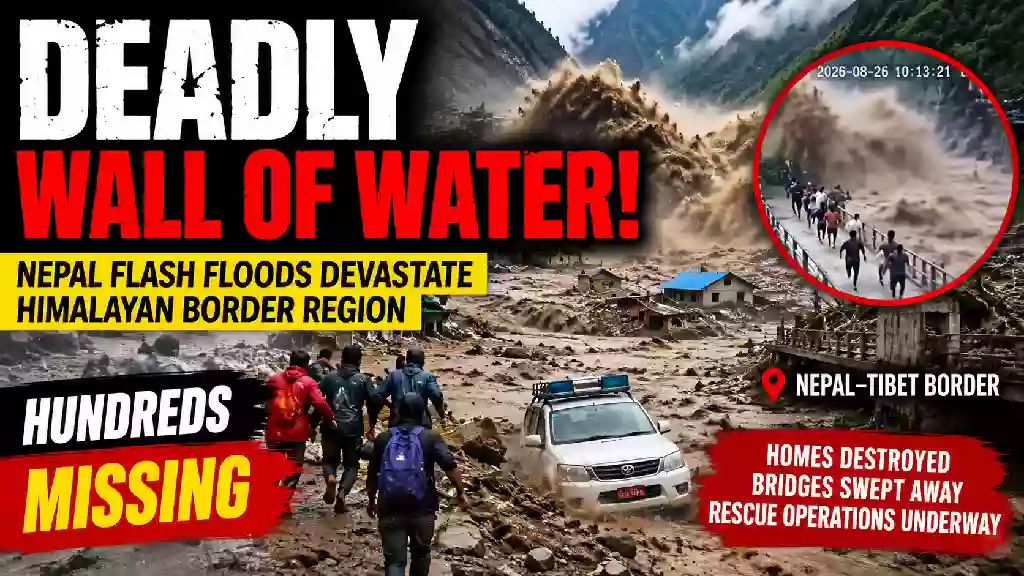
Deadly flash floods unleash a massive wall of water, mud and debris across Nepal’s Himalayan border region, destroying homes and bridges as rescue teams search for hundreds of missing people.
Nepal Flash Flood Disaster Leaves Hundreds Missing as Himalayan Border Region Is Devastated
DEADLY WALL OF WATER: Nepal Flash Floods Devastate Himalayan Border Region Hundreds Missing
A catastrophic flash flood in northern Nepal has devastated communities near the border with Tibet, sweeping away homes, roads, bridges and critical infrastructure while leaving hundreds of people missing.
The disaster struck suddenly in the Himalayan region on Wednesday, August 26, sending a powerful surge of water, mud and rocks through mountain valleys. The latest reports indicate that at least 160 people have died in Nepal and Tibet, while hundreds more remain unaccounted for.
The scale of the disaster continues to emerge as rescue teams struggle to reach some of the hardest-hit areas.
Massive Flood Sweeps Through Nepal-Tibet Border Region
Witnesses described hearing a terrifying roar before enormous quantities of water, mud and boulders came rushing through the valleys.
The torrent swept through settlements and damaged major transportation routes, power infrastructure and other facilities. Video footage from the border area showed people attempting to escape moments before a massive wall of mud and water overwhelmed buildings and vehicles.
The sudden flooding gave many residents little time to react. The original BBC report described witnesses seeing huge waves of water, boulders and mud destroying houses, bridges, offices and power stations.
Hundreds of People Remain Missing
The number of missing people remains one of the biggest concerns as authorities continue search-and-rescue operations.
Current reports indicate that more than 400 people are unaccounted for, including hundreds of foreign visitors. Nepal’s Tourism Board reported 403 tourists missing, including 341 foreign nationals and 62 Nepali tourists. Indians make up the largest group among the missing foreign tourists, followed by nationals from the United States, Australia, the United Kingdom and Canada.
The earlier BBC report warned that casualty figures could increase as rescuers reached isolated communities and officials assessed the destruction.
What Caused the Catastrophic Flood?
Early information points toward a glacial collapse or ice-and-rock avalanche as a major factor in the disaster.
The exact chain of events was still being investigated in the BBC report. Scientists and experts suggested that a large mass of ice may have destabilized and collapsed, sending enormous quantities of water and debris into a river. The resulting blockage may then have released a sudden surge downstream.
More recent analysis has also pointed to an ice-rock avalanche entering the Lhende Khola River. Reuters reported that the lower portion of a glacier collapsed and that an avalanche of ice and rock surged into the river, triggering devastating flooding.
The event highlights the growing danger posed by rapidly changing conditions in the Himalayan mountain environment.
Critical Infrastructure Destroyed
The flood has caused extensive damage to infrastructure throughout the affected region.
Roads and bridges have been destroyed, while hydropower facilities and other essential sites have been damaged or swept away. The destruction has severely complicated transportation and communications and made it more difficult for rescue teams to reach isolated communities.
The BBC report said drinking-water systems, roads and hydropower stations were among the critical infrastructure affected.
More recent reporting indicates that dozens of kilometres of roads and numerous bridges were damaged, further isolating communities affected by the disaster.
Rescue Efforts Hampered by Mountain Terrain
Emergency crews are facing enormous challenges as they attempt to locate survivors and reach people trapped by the flooding.
The affected region is remote and mountainous, with damaged roads and bridges limiting ground access. Helicopters have also faced difficult conditions, including strong winds and unsafe landing areas.
The BBC reported that more than a dozen helicopters, including military aircraft, had been deployed during the early rescue effort.
Authorities have also warned people living downstream to remain alert because additional flooding and other secondary disasters remain possible.
Tourists and Religious Pilgrims Caught in Disaster
The timing of the disaster has raised particular concern because August is a busy period for tourists, trekkers and religious pilgrims traveling through the Himalayan region.
The route affected by the flooding is used by people traveling toward Mount Kailash and Mansarovar, while Hindu pilgrims also travel through the region toward destinations such as Bosaikunda.
The BBC reported that the approaching Janai Purnima festival had increased travel in the area, potentially placing additional pilgrims on routes affected by the disaster.
A Growing Climate Risk in the Himalayas
The disaster is also drawing renewed attention to the changing Himalayan environment.
Scientists have warned that rising temperatures are contributing to glacier and ice-field loss across the region. As glaciers retreat and unstable ice and rock formations become more vulnerable, communities living downstream can face dangerous flooding events.
The precise role of climate change in this particular disaster will require further scientific investigation. However, experts have increasingly warned that a warming Himalayas could intensify risks associated with glacier melt, unstable slopes and sudden floods.
Nepal Faces a Long Road to Recovery
The full human and economic cost of the disaster is still being determined.
For survivors, the immediate priorities are shelter, food, drinking water, medical assistance and safe transportation. For authorities, the challenge is to locate missing people while restoring roads, bridges, communications and damaged power infrastructure.
The disaster is another painful reminder of Nepal’s vulnerability to extreme natural events. The country suffered devastating floods in previous years and was struck by a massive earthquake in 2015 that killed more than 9,000 people and injured approximately 22,000.
As rescue operations continue, families across Nepal and around the world are waiting for news about loved ones still missing.
The immediate priority remains clear: find survivors, reach isolated communities and prevent further loss of life as authorities confront one of the most devastating flood disasters to hit the Himalayan region in years.
#NepalFloods #NepalFlashFloods #NepalDisaster #Nepal2026 #HimalayanFloods #Tibet #Rasuwa #FlashFlood #Mudslide #GlacialCollapse #NepalNews #BreakingNews #NaturalDisaster